

Last week, a colleague said to me that she was “Done with LinkedIn!” Her concern was “the loss of pragmatism and adult business protocol swallowed by posturing and performative flexing.” You could hear the stored momentum in her words, it was the kind of line that only shows up after a long internal build. It made me think, LinkedIn has always had a bit of theater in it, but traditionally there were some inherited guidelines from the real world and perhaps those have shifted.
For instance, business people always knew the difference between what happens on a trade show floor and what happens in a boardroom. On the floor you posture a bit, polish your pitch, wave your hands around, and try to gather attention in a room full of other people waving their hands around. In the boardroom you sit still, talk less, and measure your words. Both modes have their place and everyone understands the boundary.
What feels different now is that LinkedIn has blurred that line almost entirely. The floor has expanded. It has swallowed the lobby, the conference hall, and most of the serious rooms where people used to behave with measure.
After thinking about it, I realized my feed is now full of people with “50 Million Exit” in their bios, “Coaching Founders to Greatness” in their banners, and inspiring carousels about resilience sandwiched between ads for a course they built last Tuesday. Ok, perhaps that is harsh, but I think there is more of that sort of thing than ever. I am going to avoid deciding this is a crisis signalling the end of good behaviour. I would prefer to think of it as a shift in incentives. The algorithm rewards attention more than it rewards competence. It does not know the difference between a thoughtful operating insight and a chest thumping victory lap masquerading as a life lesson. So naturally the feed fills up with whatever gets immediate hits.
If you have a low tolerance for loud posturing, this can make LinkedIn feel like a strange place to spend time. The operators, the people with real jobs and real constraints, still post. They are just harder to find because they do not shout. They write the way they work. Clean, competent, a little dry. They talk about what they are trying to solve, what they have learned, what they would do differently. They share early signals of things worth paying attention to. They go easy on the heroics, the personal brand elevation, the virtue signalling.
That is what I enjoy. I like hearing how people actually think. I like following where former colleagues landed and seeing what they are building. I like picking up the faint buzz around an idea that might become something real. All of that still exists on LinkedIn. It is just slightly obscured by noise, gushing and unchecked overstatement.
The trick is to remember what room you are in. LinkedIn is not a boardroom. It is a trade show floor. People in costume, shouting over the din, hoping a stranger stops long enough to scan their badge. We all like the spectacle of a good trade show! At the same time, there are still serious folks who walk the floor without shouting. They nod, make eye contact, stay curious, and move on.
If you keep that in mind, it becomes easier to stay present without getting irritated. You can let the barkers bark. You can ignore the “90 Million Exit” titles without needing to audit anyone’s cap table. And you can keep using the platform for what it is still good at, even if you have to brush past a few inflatable mascots on the way.
In the end it is simple. Behave like someone who knows what room they are in. And do not forget that you are allowed to leave the floor whenever you want.
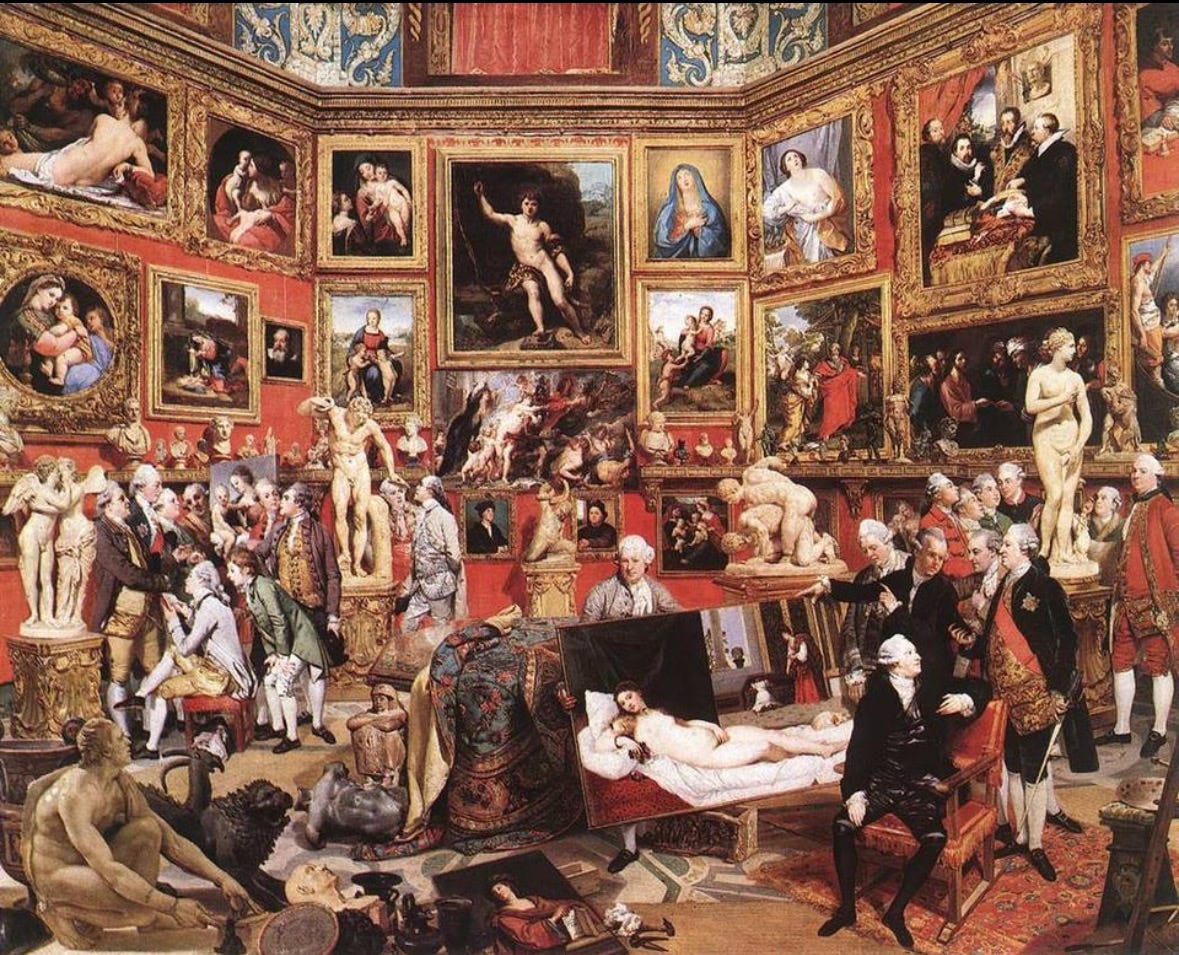
The Tribuna of the Uffizi (1772–1778) by Johan Zoffany captures a crowd of connoisseurs performing their expertise in a packed gallery, each gesturing at something different. It is a study in noise, attention, and the small group of quieter figures trying to focus amid the theatrics.