

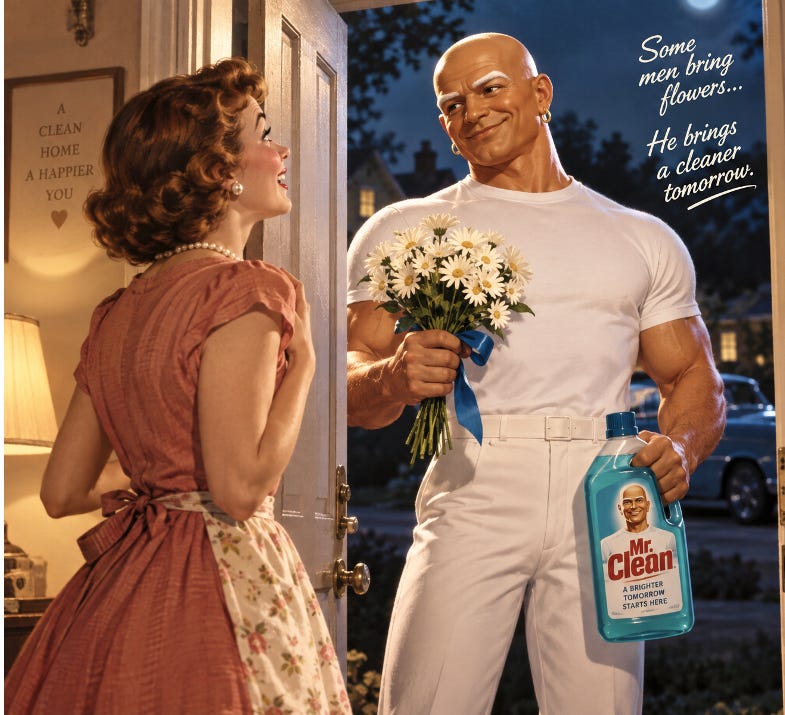
I found myself looking at a bottle of Mr. Clean recently and had a question I suspect very few people have bothered asking in the last sixty years:
What the hell is this guy?
He’s enormous, bald, Immaculately dressed in a skin-tight white T-shirt. He has one gold hoop earring, his arms are permanently folded in the manner of a man who is extremely confident about what he’s about to do to your kitchen floor. And somehow none of this seems strange. I decided I NEED find out more about his origin story.
Mr. Clean has been around since 1958. The character was conceived as a kind of cleaning genie, which at least begins to explain the otherwise baffling collection of visual clues. The product was originally developed by Linwood Burton, who ran a marine cleaning business and wanted an alternative to the harsh solvents then in use. Procter & Gamble acquired it, commercial artist Richard Black designed the character, and one of the most recognizable advertising mascots in history was born.
The interesting part isn’t really Mr. Clean. It’s that someone had to invent Mr. Clean. Every element that now seems inevitable was once a decision.
Advertising for household products in the 1950s was overwhelmingly directed at women. So why make the embodiment of household cleaner a man? Presumably because he wasn’t supposed to represent the person doing the cleaning. He represented the power of the cleaner itself.
And apparently cleaning power looks like it can bench-press you.
There’s also something faintly sexual going on. Huge arms, tight shirt and confident smile but also carefully pushed out of the category of actual available man and into something safer ... and stranger. He’s part sailor, part genie, part nightclub bouncer who has become unusually concerned about soap scum. The earring does enormous work here. Without it, he’s an escaped orderly from a 1950s psychiatric hospital. With it: mysterious maritime genie. The underlying fantasy is actually pretty good advertising:
Not: Mrs. Housewife, look how good you can be at cleaning.
More: Lady, stand aside. This enormous bald bastard has the kitchen!
What interests me is how completely all of that weirdness disappears with time. Nobody looks at Mr. Clean anymore and sees a sequence of bizarre decisions made by illustrators, advertising executives, brand managers and probably several nervous men in suits staring at drawings on an easel. We just see … Mr. Clean.
The decisions worked so well that they stopped looking like decisions. And an enormous amount of the world around us is like this. Logos, packaging, corporate language, clothing, architecture, movie conventions, the noises our phones make; somebody chose all of it; usually for a reason. Then we encountered it often enough that the reason vanished and the thing itself became part of the scenery.
We know intellectually that culture is constructed, but we don’t experience it that way. We experience most of it as though it simply arrived. Which is why occasionally asking “Who decided this, and what the hell were they thinking?” is surprisingly revealing.
Sometimes the answer is a complicated little story about gender, aspiration, domestic labour and mid-century advertising. And sometimes the answer is:
We think women will trust a bald sailor-genie to clean the bathtub.