

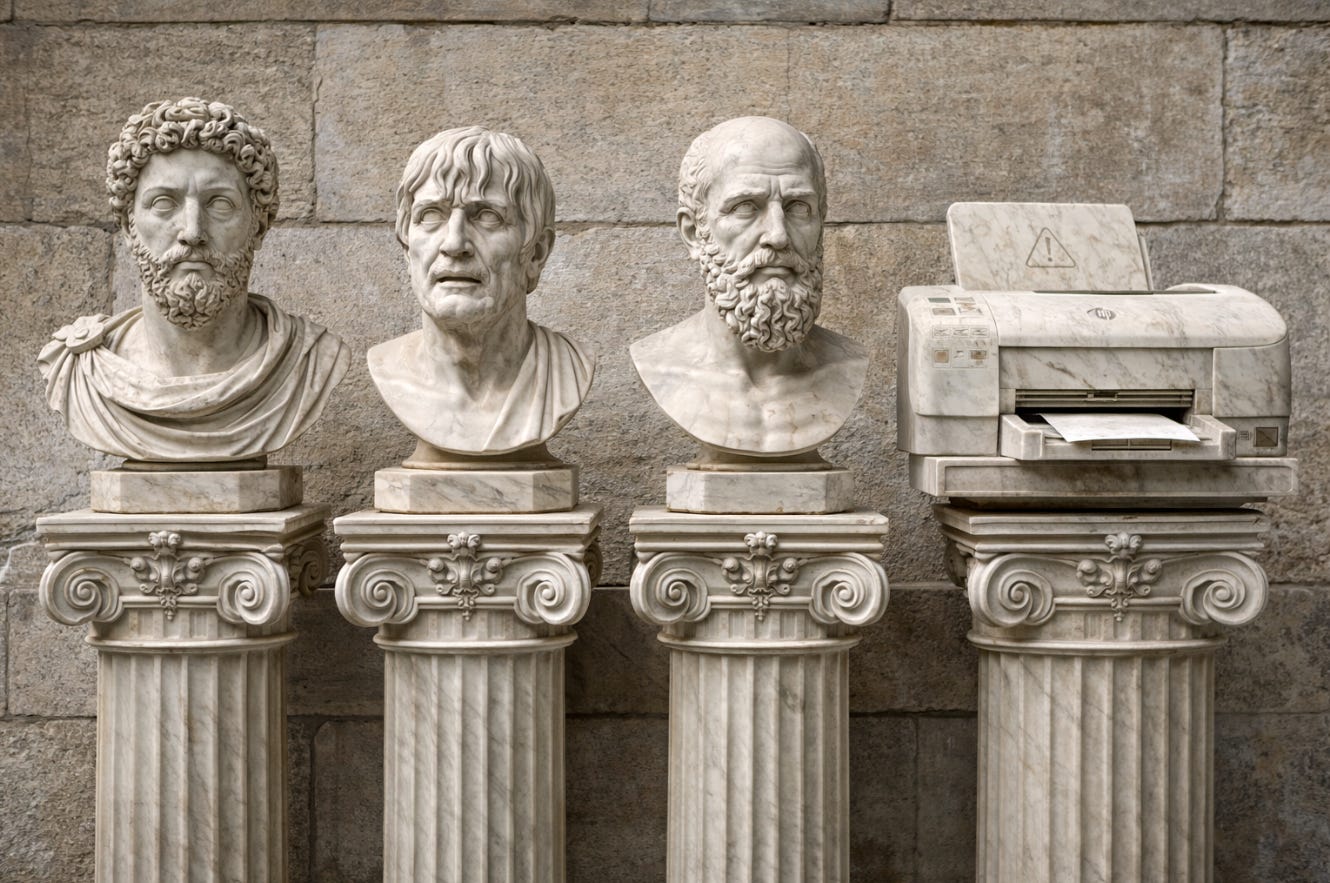
Printers occupy a strange place in modern life. They are devices that almost never work properly, yet the entire world behaves as if they do. Somewhere in a product brochure a printer is depicted calmly producing page after page of perfect documents while a smiling professional nods approvingly. In the real world the printer is blinking a hieroglyphic error code, claiming it is out of cyan even though you are printing in black, and insisting that the paper tray is both empty and jammed at the same time. This is not a rare failure; it is the standard operating condition. How has it come to this and why as a society did we allow this to happen?
The underlying reason is economic theatre; printers are not built to work. They are built to exist long enough to sell ink and replacement units. If a printer truly worked like a toaster or a kettle, you would buy one every ten-year years and forget about the category entirely. Instead we live in a cycle of ritual troubleshooting, restarting, cleaning the heads, align the cartridges, download drivers, reinstalling drivers, updating firmware and that dreaded thing where the printer has simply taken a vacation from being part of the WIFI network and can’t be reached right now. The industry has discovered a remarkable business model: Sell a machine that functions just well enough that people blame themselves when it fails.
A Stoic philosopher would approach the printer differently. Marcus Aurelius would remind us that the printer is not ours to command, only our reaction to it. Epictetus would calmly note that the printer belongs in the category of things outside our control, alongside weather, politics, and other people’s opinions. Seneca might advise that one should rehearse adversity in advance and therefore assume from the beginning that the printer will not work. In this light the printer becomes not a device but a training instrument for character: The blinking error light is a lesson in detachment, the paper jam is a meditation on impermanence, the printer-not-found is an invitation to cultivate patience. Of course the Stoics did not have school permission slips that must be printed and signed at eleven at night, so their philosophy might soften slightly when confronted with modern bureaucracy.
Which brings us to the final Stoic conclusion. The rational answer is obvious: do not own a printer. I tried, but the world is not yet designed for that reality. A form appears that demands wet ink as if we are still operating a colonial trading post, a kid’s school project requires printed images of volcanoes, a government document refuses to acknowledge the existence of electrons. So we keep the printer in the corner like an unreliable relative. We know it will disappoint us, we know it will waste our time. The Stoic solution, then, is not to expect it to work.
And, at some point, the realization dawns that the printer industry solved its problem perfectly; the machine does not need to work, it only needs to exist.